
How to make flashcards that actually work
In short: Ask one question on each card. Answer before you flip. Keep a bigger stack and return to it on other days.
Flashcards look almost too simple to need instructions. You write a question on one side, an answer on the other and flip until it sticks. Yet plenty of students end up with a tall, beautiful stack that teaches them very little, usually because the cards ask too much, or because flipping has quietly replaced thinking.
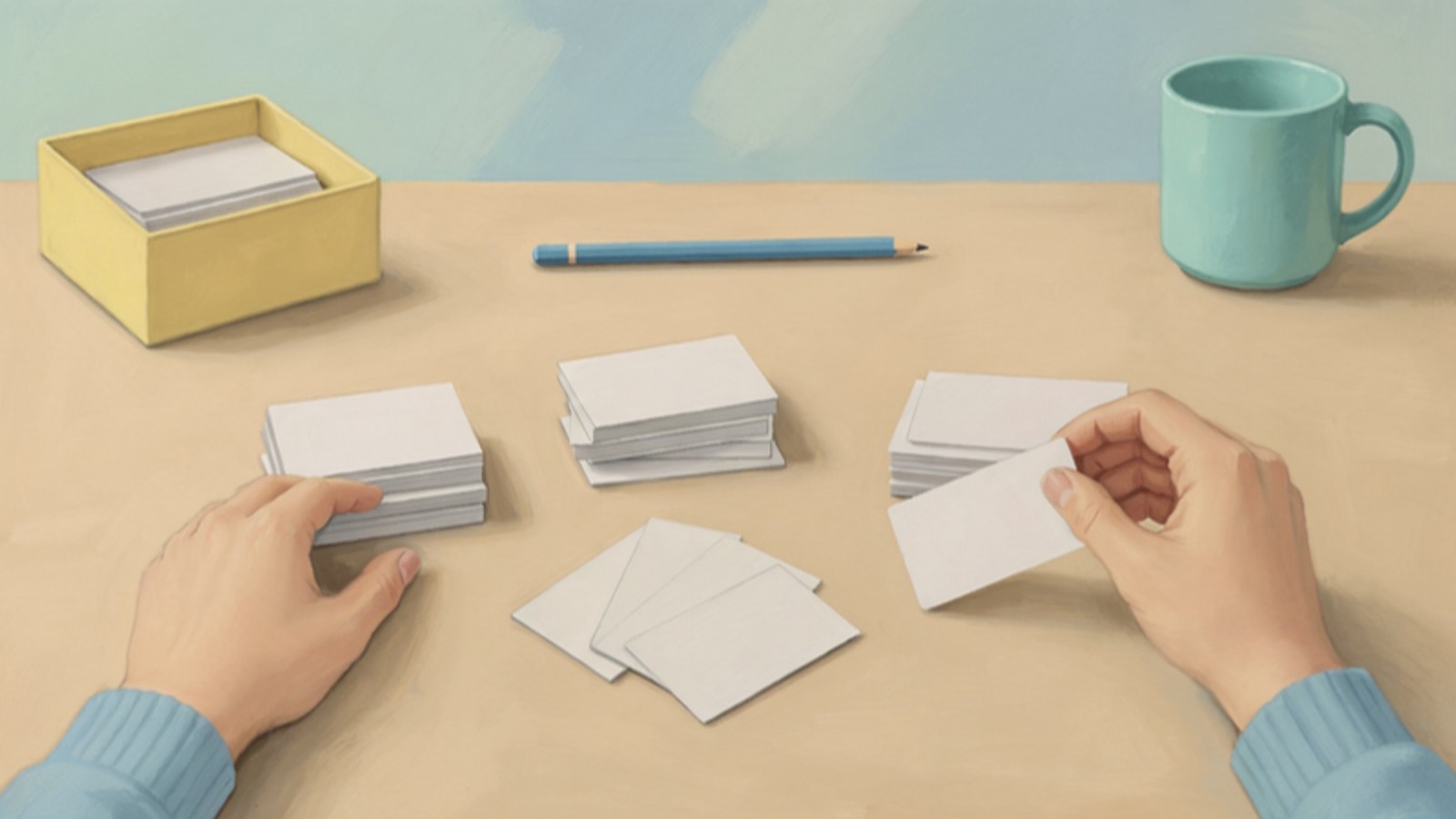
A good card does one small job. It asks you something, makes you wait for a moment while your memory works, and then tells you whether you were right. That waiting moment is the part worth protecting. A large review of study techniques rated practice testing as highly useful (Dunlosky et al., 2013), and a flashcard used properly is a tiny test you can carry in your pocket.
Write one question per card
The most common mistake is the card that holds a whole lecture. If the back has nine bullet points, you will remember six, feel unsure whether that counts and move on. Split it. Nine small cards take a little longer to write, and each one gives you a clear yes or no.
Ask for an answer you have to produce. "Photosynthesis" on the front invites a vague nod, while "What does a plant take in and give off during photosynthesis?" leaves less room to bluff. Questions that begin with why, how or what is the difference are useful when understanding matters more than a single term.
| Weaker card | Stronger card |
|---|---|
| The French Revolution | What financial problem pushed the French crown to call the Estates-General in 1789? |
| Define osmosis, diffusion and active transport | Which of diffusion and active transport requires energy from the cell? |
| Mean, median, mode | Which average is least affected by one extreme value? |
Write the cards in your own words, using your lecture notes as raw material. Deciding what to ask is a small act of study in itself. Shared decks can save time, though you should check them against your course before trusting them.
Answer before you flip
Say the answer out loud or write it down, then turn the card. It feels slow, and it is easy to skip when you are tired. But a glance followed by "yes, I knew that" is recognition, which is a much gentler challenge than the one waiting in the exam. Our guide to testing yourself explains why the difference matters.
Do not retire a card the first time you get it right. Karpicke and Roediger (2008) had university students learn foreign vocabulary. After a word had been recalled once, continued testing greatly improved later recall, while continued study without testing had no effect on it. The students' own predictions did not match how well they went on to do.
A fair rule: keep a card in play until you have answered it correctly on three different days. The number three is a practical habit, not a research result.
Keep the stack big and spread it out
Small stacks are satisfying because you master them quickly. The catch is that each card comes back almost at once, while you still remember it. In three experiments with vocabulary pairs, Kornell (2009) found that one large stack worked better than four small stacks studied separately, and that spacing beat cramming on the last day. Spacing helped 90 percent of participants, although after the first session 72 percent believed the massed approach had worked better.
You do not need an enormous pile. Keep the cards for one course or exam topic together, go through them, and return another day. Missed cards can come round again sooner. A box with three sections for new, shaky and solid cards does the sorting nicely, and spaced repetition apps can schedule it for you.
Fix the cards that keep failing
Some cards you will miss again and again. Treat that as a hint about the card as much as about your memory. It may ask two things at once, use words you do not understand or sit too close to a neighbour that looks just like it. Rewrite it, add an example or go back to the source and learn the idea properly first.
Flashcards are good at terms, facts, steps and distinctions. They are weaker practice for a long argument or a multi-step problem, so pair them with past questions. Fit both into a two-week plan, and by the night before the exam your shaky pile should be small enough to hold in one hand.
Try it tonight: Take your worst crowded card and split it into three small questions. Answer all three out loud.
Common questions
How many flashcards should I make?
As many as the material needs, one question on each. Start with the topics you find hardest rather than turning every page into cards.
Paper cards or an app?
Both work. Paper is simple and needs no setup. An app schedules reviews for you, which helps when the stack grows.
When can I stop reviewing a card?
Not after the first correct answer. A practical habit is to keep it until you have answered it correctly on three different days.
References
Dunlosky, J., Rawson, K. A., Marsh, E. J., Nathan, M. J., & Willingham, D. T. (2013). Improving students’ learning with effective learning techniques: Promising directions from cognitive and educational psychology. Psychological Science in the Public Interest, 14(1), 4–58. https://doi.org/10.1177/1529100612453266
Karpicke, J. D., & Roediger, H. L., III. (2008). The critical importance of retrieval for learning. Science, 319(5865), 966–968. https://doi.org/10.1126/science.1152408
Kornell, N. (2009). Optimising learning using flashcards: Spacing is more effective than cramming. Applied Cognitive Psychology, 23(9), 1297–1317. https://doi.org/10.1002/acp.1537